
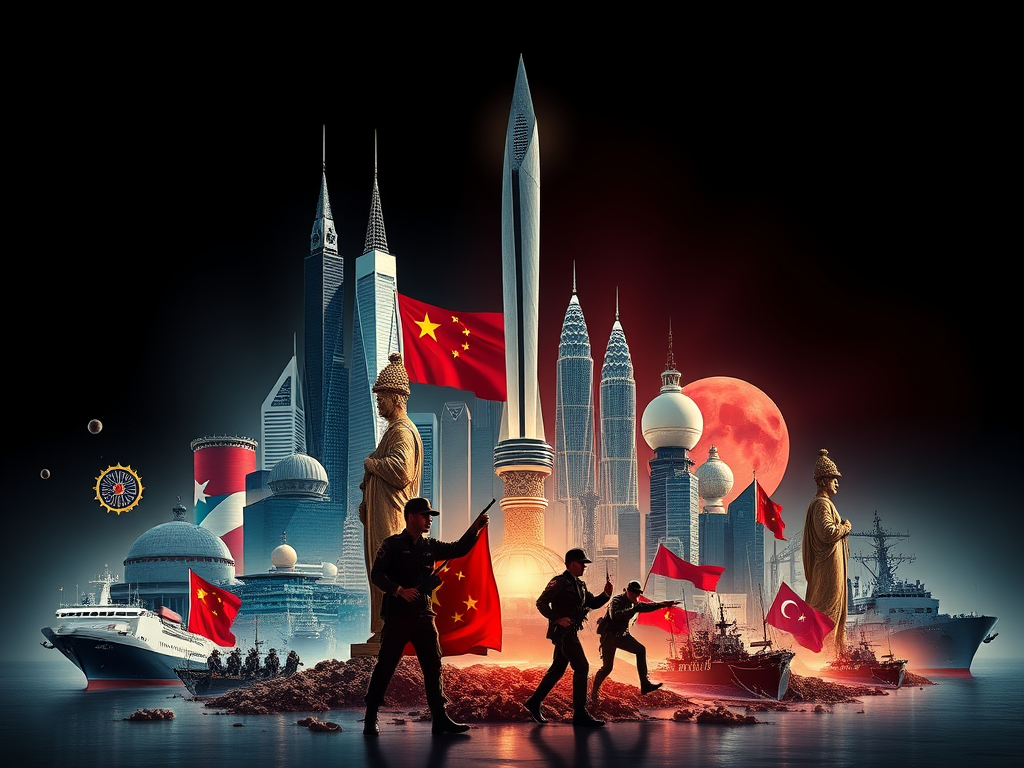
China’s rise to power aligns with realist prediction of how states rapidly build up their military to maximize their power and protect their national interests. Realism is a pessimistic theory that views the world as an unsafe and dangerous place where states cannot trust each other. In realist theory, countries need power to defend their national interests, and power is seen as the currency of international politics (Mearsheimer, 2006).
Yet in Southeast Asia, the response to China’s ascent is not as straightforward as realism might expect.
This analysis explores whether Southeast Asian countries are balancing against China through the lens of realist theory. I learned that Southeast Asian countries are engaging in a hybrid strategy of balancing and hedging, closely looking at case studies of Southeast Asian maritime countries like Malaysia, Indonesia, and the Philippines, as well as mainland countries including Vietnam, Cambodia, and Laos.
Realism, Power, and China’s Rise
Mearsheimer explained that the nature of the state determines why they want power, and this is something that divides the different realist theories. Classical realists argue that human nature causes states to pursue power and dominate rivals, while structural realists emphasize the anarchic international system, where the absence of a central authority forces states to seek power for survival.
This system of striving for maximum power creates a security dilemma in geopolitics, as states race to secure their national interests, which accounts for the balance of power strategy. Balance of power is a system in realist theory that makes it almost impossible for a state to achieve hegemony. It is prompted when one state exponentially expands its power, causing its neighbors to cooperate and balance against them.
China’s increasing military buildup in its region is expanding at an alarming rate. It directly follows the realist playbook of maximizing the power gap in a region. China is looking to become a major superpower, exerting military force so no other nation in the region can oppose them, including the United States.
China’s rise also brings into question John Mearsheimer’s “The Tragedy of Great Power Politics”, which argues that ambitious states that continue to expand their power are likely to meet resistance and eventual decline (Mearsheimer, 2021).
Why Southeast Asia Does Not Balance in the Expected Way
The current trajectory of China’s rapid rise to power has created a complex geopolitical system in the Southeast Asia region. Heritage Foundation researcher Jeff M. Smith noted that balancing in the region is happening less than what realist theorists might have expected.
Southeast Asian states are pursuing constructive balancing strategies across political, economic, and diplomatic engagement with China, while simultaneously increasing military buildup and security alliances to counter China’s growing threat.
The rise of China has caused a dramatic shift in the patterns and composition of Southeast Asia’s diplomatic maneuvers, as most states seek to maximize their maneuverability against what they view as regional domination by any superpower.
Hedging as the Dominant Strategy
The geopolitical order in Southeast Asia has created a complex system of political and economic interdependencies. States in the region maintain a position of equidistance between China and the United States, aiming to preserve a multipolar balance while overcoming geopolitical pressure. This is why most states pursue a hedging strategy toward China.
Lowy Institute research shows that China has expanded its overall margin of influence in Southeast Asia, particularly through bilateral economic ties (Patton and Sato, 2023). At the same time, traditional US allies in the region acknowledge that the United States remains the “ultimate guarantor” of regional stability (Heisbourg, 1999–2000).
How Countries Hedge Differently
Malaysia engages economically with China while strengthening its military—an example of internal balancing. Kuala Lumpur has secured arms purchases from China following diplomatic defense dialogue, expanding defense cooperation through military exercises, international forums, and defense industry collaboration.
In contrast, the Philippines leans more heavily on external balancing. Manila has strengthened its alliance with Washington and increased its defense budget by 21.6 percent from 2023 to 2024 due to South China Sea disputes, while constructing ports near the contested Ayungin Shoal.
Singapore has also deepened security cooperation with the United States while Indonesia, Southeast Asia’s largest economy, maintains economic interdependence with Beijing while adopting a cautious strategic posture, as China remains one of Jakarta’s largest trading partners and investors.
Meanwhile, mainland Southeast Asian countries such as Cambodia and Laos continue to strengthen defense cooperation and economic engagement with Beijing (Yaacob, Patton and Sato, 2025).
Why Geography and History Matter
Southeast Asia occupies a strategic maritime region connecting East and West, making it a focal point of great power competition. Historically, the region endured colonial domination and imperial expansion, experiences that continue to shape regional caution toward any single hegemonic power.
In the 21st century, many ASEAN states rely on the United States as a key security provider, particularly as China asserts its claims in the South China Sea through the nine-dash line, which overlaps with the exclusive economic zones of the Philippines, Malaysia, Brunei, and Vietnam.
Lowy Institute data indicates a growing complexity in defense cooperation agreements between Southeast Asian states and middle powers such as Australia, Japan, India, South Korea, and Canada between 2017 and 2024. These partnerships help states maintain autonomy and avoid overdependence on either Washington or Beijing.
Southeast Asian states do exhibit elements of balancing against China, but their strategic behavior is best described as hedging—seeking autonomy and flexibility in a region dominated by competing superpowers.
China’s assertiveness in the South China Sea has pushed states to strengthen internal defense and seek external partners, while Beijing continues to use economic and diplomatic incentives to deter opposition (Cho and Park, 2013). This dynamic produces uncertainty and cautious maneuvering rather than outright confrontation.
Understanding Southeast Asia’s response to China requires attention to three factors: the depth of economic interdependence, the role of South China Sea disputes, and historical experiences with external domination. While China may view Southeast Asia as its strategic backyard, the region continues to rely on the United States as its preferred security partner.
The geopolitical order in Southeast Asia has created a multilayered system of political and economic interdependencies. States maintain equidistance, pursue a multipolar balance, and maximize maneuverability. Balancing exists—but hedging remains the dominant strategy.